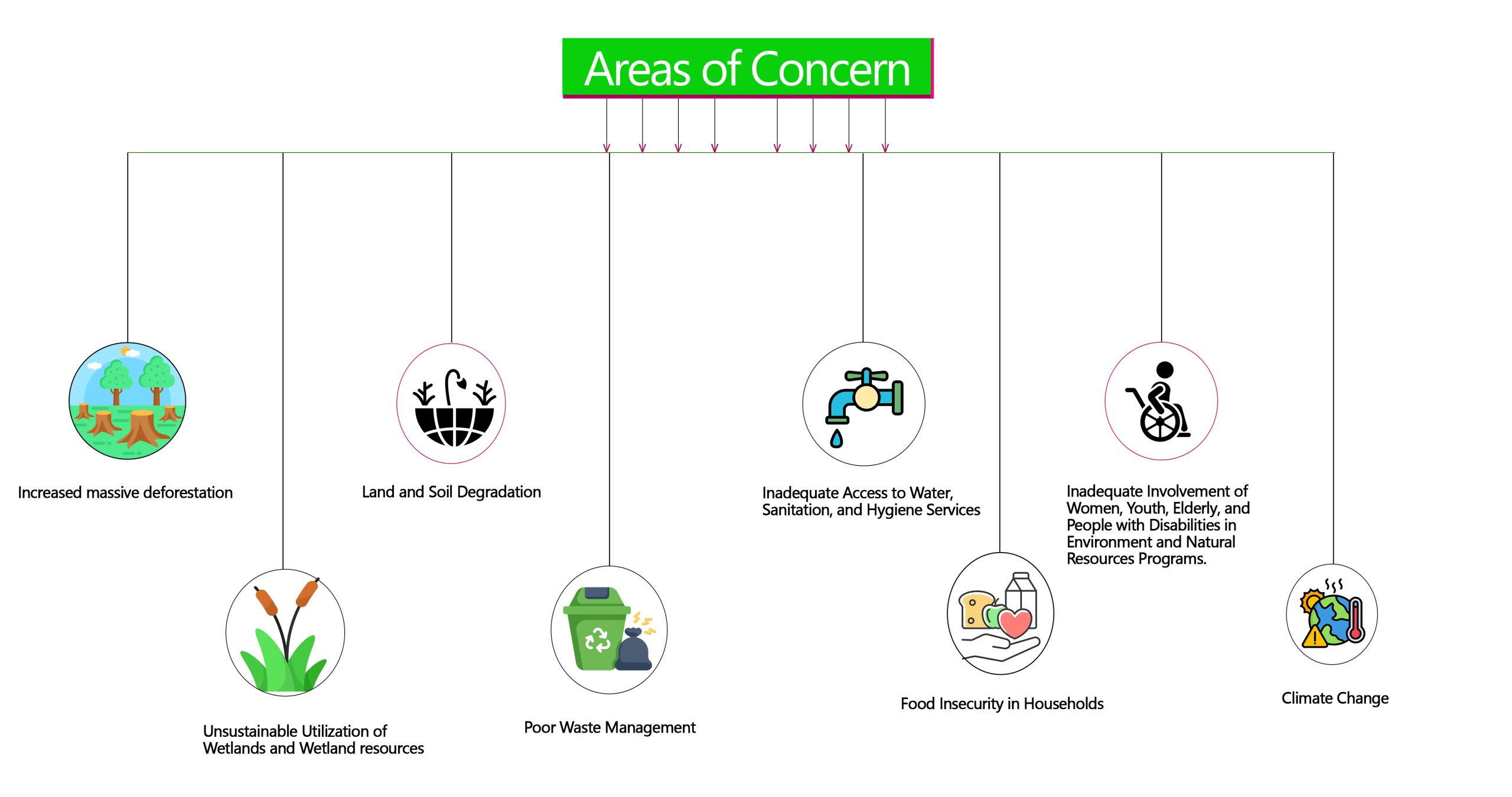
 1. Increased massive deforestation.
Uganda has lost a significant proportion of its forest cover over the past decades due to agricultural expansion, commercial charcoal production, timber harvesting, and infrastructure development. This rapid deforestation has weakened water catchment areas, reduced biodiversity, disrupted rainfall patterns, and increased the frequency of floods and droughts, particularly in regions such as the Albertine Graben, Mount Elgon, and the Lake Victoria basin.
In response, Environmental Alert (EA) has been implementing community-led forest and landscape restoration interventions that promote sustainable land use, tree growing, and protection of critical water catchments. Through policy advocacy, capacity building of local governments and communities, and the coordination of multi-stakeholder initiatives such as the Running Out of Trees (ROOTs) Campaign, EA works to address the drivers of deforestation while strengthening community resilience and sustainable natural resource governance.
Click here to See The Uganda National Agroforestry Strategy
2. Unsustainable utilization of wetlands and wetland resources
Wetlands in Uganda play a vital role in water purification, flood control, and climate regulation, yet they continue to face severe degradation due to encroachment and weak enforcement of existing policies, especially in rapidly urbanizing areas.
In alignment with the National Wetlands Strategic Plan, Environmental Alert (EA) works with communities, local governments, and national institutions to strengthen wetland governance, promote regulatory compliance, and support sustainable livelihoods. EA’s interventions have contributed to increased public awareness, improved stakeholder coordination, restoration of degraded wetland areas, and enhanced community participation in wetland management, particularly in urban and peri-urban settings.
3. Land and soil degradation
Poor land-use practices, over-cultivation, deforestation, and limited adoption of soil-conservation measures have led to widespread soil erosion and declining soil fertility, especially in Eastern and Northern Uganda.
This degradation threatens agricultural productivity, undermines rural livelihoods, and increases household vulnerability to climate shocks.
4. Poor waste management
Uganda continues to face major challenges in waste management, particularly in urban and peri-urban areas. Limited waste collection coverage, open dumping, and weak recycling systems have led to increased plastic pollution in drainage channels, wetlands, and water bodies such as Lake Victoria. This not only contributes to flooding but also poses serious public health and environmental risks.
5. Inadequate access to Water, Sanitation, and Hygiene services
Although progress has been made, many rural and urban informal settlements in Uganda still lack access to safe drinking water, improved sanitation, and adequate hygiene facilities. Poor WASH services contribute to waterborne diseases, environmental contamination, school absenteeism, and reduced productivity, particularly affecting women and children.
6. Food Insecurity in Households
Food insecurity remains a major concern in Uganda, driven by climate variability, declining soil fertility, land fragmentation, and limited access to climate-smart agricultural technologies. Prolonged droughts, floods, and pests continue to disrupt food production, especially in Karamoja, Teso, and parts of Northern Uganda, increasing malnutrition and poverty levels.
7. Inadequate Involvement of Women, Youth, the Elderly, and People with Disabilities in Environment and Natural Resources Programs.
Despite their central role in natural resource management, women, youth, older persons, and persons with disabilities are often inadequately involved in environmental governance and decision-making processes in Uganda. Structural inequalities, limited access to information, land ownership barriers, and weak representation continue to constrain their meaningful participation in Environment and Natural Resources (ENR) programmes.
Environmental Alert (EA) deliberately integrates inclusive and gender-responsive approaches across its ENR interventions by strengthening the capacity of women and youth groups, supporting community leadership and advocacy skills, and promoting equitable participation in policy dialogue and local governance structures. EA works with communities and institutions to amplify the voices of marginalized groups, ensuring that ENR policies and programmes are more inclusive, equitable, and responsive to diverse community needs.
8. Climate Change
Uganda is increasingly experiencing the impacts of climate change, including erratic rainfall, prolonged droughts, floods, landslides, and rising temperatures. These impacts are already straining water resources, agriculture, health systems, and infrastructure, while exacerbating existing environmental degradation and socio-economic inequalities.